
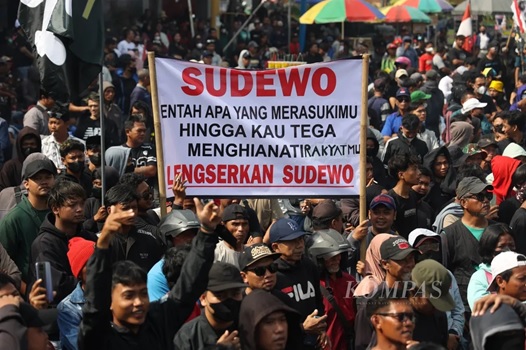
The phenomenon of the Land and Building Tax (PBB) hike in Pati Regency, set to take effect in early 2025, stems from a drastic increase of up to 250%—with a hike of as much as 7,000% having even been proposed (detikjateng.com). Residents of Pati Regency have complained that their annual tax obligations have surged from hundreds of thousands to millions of rupiah. This situation demonstrates that fiscal policy can directly impact residents’ lives—particularly those with low incomes—potentially placing them at risk of being unable to remain in their homes.
This large-scale PBB increase could also trigger gentrification and social exclusion (Situmeang & Adrison, 2022). Low-income residents will struggle to retain their homes, likely leading to a shift in land and housing ownership toward wealthier groups and a change in property use. This ownership shift, driven by the tax hike, reveals a failure to implement the principle of inclusive housing in practice, as it instead fosters spatial injustice.
This phenomenon could also exacerbate Indonesia’s high housing backlog. According to data from the Ministry of Public Works and Public Housing (PUPR)—as cited by the Director General of Infrastructure Financing, Herry Trisaputra Zuna, during the Property Outlook 2024 event—the national housing backlog stood at 12.7 million units in 2023 (VOI, 2024). Consequently, the PBB hike threatens to intensify Indonesia’s housing crisis. Such an increase is particularly detrimental to low-income communities; the tax surge—rising five- to seven-fold—disrupts the balance between residents’ income and the funds allocated for housing costs. According to data from BPS (Statistics Indonesia), housing costs account for a significant portion of average household expenditure, whereas international standards suggest that housing costs should ideally not exceed 30% of total spending (UN-Habitat, 2008). This surge in the Land and Building Tax (PBB) pushes the proportion of housing expenditure beyond reasonable limits, threatening to displace vulnerable residents from their neighborhoods. If left unaddressed, this trend will widen social inequality and exacerbate the problem of urban fringe slums.
The tax hike is also likely to accelerate land-use conversion, potentially reducing local green open spaces. High tax burdens will drive landowners to sell their assets for conversion into commercial areas. This could conflict with Law No. 26 of 2007, which mandates that urban areas maintain a minimum of 30% green open space. As an agricultural region, Pati Regency—currently facing this tax increase—risks losing its agrarian identity to gentrification driven by the fiscal pressure of the rising PBB.
If implemented, this PBB hike would have a severely detrimental impact on the community. The PBB should serve as an instrument that fosters spatial justice and alleviates the housing crisis. The situation in Pati Regency demonstrates how fiscal governance and policy directly affect people’s lives. Consequently, the local government should consider progressive tax schemes and support residents in accessing affordable housing and productive land. In doing so, the PBB—and other tax policies—can align with goals for regional development that are sustainable, inclusive, and community-oriented. (TAm)
Sumber:
DetikJateng. 2025. “Sederet Fakta Usulan Kenaikan PBB Pati yang Sempat Menyentuh 7.000 %.” Diakses dari https://www.detik.com/jateng/berita/d-8073180/sederet-fakta-usulan-kenaikan-pbb-pati-yang-sempat-menyentuh-7-000 pada 25 Agustus 2025.
Situmeang, M. T., & Adrison, V. (2022). Non-Compliance with Land and Building Tax – Rural and Urban (PBB-P2) in Special Capital Region of Jakarta. Jurnal Manajemen Pelayanan Publik, 5(2), 208. https://doi.org/10.24198/jmpp.v5i2.37020
UN-Habitat. (2008). Housing for all: the challenges of affordability, accessibility and sustainability. Human Settlements Finance and Policies.
VOI. 2024. “Kementerian PUPR Sebut Backlog Perumahan Capai 12,7 Juta Keluarga.” Diakses dari https://www.voi.id/ekonomi/360617/kementerian-pupr-sebut-backlog-perumahan-capai-12-7-juta-keluarga pada 25 Agustus 2025.