
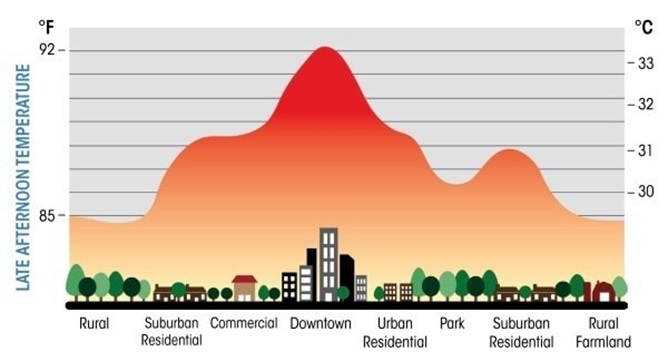
Major cities in Indonesia frequently face the problem of rising air temperatures, particularly in densely built-up city centers. According to BMKG reports, major urban areas—such as Jabodetabek, Medan, Surabaya, Makassar, and Bandung—rank among the top 20% of cities with the highest Land Surface Temperatures (LST). This phenomenon of rising urban temperatures is known as the Urban Heat Island (UHI) effect. Amidst rapid urbanization, UHI has become a critical issue in urban planning due to its direct impact on residents’ quality of life, public health, and urban energy consumption.
What is an Urban Heat Island?
The BMKG defines UHI as a phenomenon characterized by higher temperatures in urban areas compared to rural ones. The extent of this temperature rise varies depending on land cover. The primary cause of UHI is the modification of the land surface through urban development that utilizes heat-retaining materials, such as asphalt and concrete. The construction of roads, buildings, and other infrastructure—driven by the needs of a growing population—leads to a reduction in vegetation. Consequently, these surfaces absorb and re-radiate more heat, causing surface temperatures to rise (Khomarudin, 2004). Studies have shown that the air temperature difference between areas affected by the UHI effect and areas with abundant vegetation can reach up to 6°C. Additionally, energy consumption contributes to the rise in urban temperatures.
Negative Impacts of Urban Heat Islands
UHI creates various negative effects for urban life. Rising temperatures trigger a surge in energy consumption due to increased air conditioning (AC) usage; this drives up the consumption of electricity and fossil fuels, thereby exacerbating global warming. Other consequences include a decline in water quality and increased electricity demand. Furthermore, during the dry season, the Urban Heat Island (UHI) effect can accelerate the formation of harmful smog; precursors such as nitrogen oxides (NOx) and volatile organic compounds (VOCs) react photochemically to produce ground-level ozone. This has direct consequences for public health, triggering conditions such as heatstroke, dehydration, and respiratory issues, while also exacerbating the health of individuals with chronic illnesses. In some instances, the high temperatures associated with this phenomenon can lead to heatwaves resulting in hundreds of fatalities, particularly during the summer. Moreover, deteriorating air quality and extreme heat impact urban ecosystems, disrupting the balance of flora and fauna and altering the ecosystem as a whole.
Mitigating the Impacts of Urban Heat Islands
To address the impacts of the UHI phenomenon, various environmental organizations—such as the United Nations Environment Programme (UNEP)—have proposed several remedial solutions. These include the implementation of green roofs and green walls, the use of cool roofs, the expansion of urban green spaces, and the adoption of eco-friendly materials like porous and cool pavements. Additionally, energy conservation can be achieved through the development of eco-friendly transportation and the implementation of “Smart City” concepts that utilize energy-efficient technologies. (ERA)
Referensi:
Al Mukmin, S. A., Wijaya, A. P., & Sukmono, A. (2016). ANALISISPENGARUH PERUBAHAN TUTUPAN LAHAN TERHADAP DISTRIBUSI SUHU PERMUKAAN DAN KETERKAITANNYA DENGAN FENOMENA URBAN HEAT ISLAND. Jurnal Geodesi Undip, 224-233.
Environesia Global Saraya. (2025). Urban Heat Island: Penyebab dan Solusi untuk Kota Padat. Diakses dari https://environesia.co.id/blog/Urban-Heat-Island-Penyebab-dan-Solusi-untuk-Kota-Padat
Guntara. (2016). Pengertian Fenomena Urban Heat Island (UHI). Diakses dari https://www.guntara.com/2016/10/pengertian-fenomena-urban-heat-island.html
Hardiyanti, T. (2012, September 5). URBAN HEAT ISLAND DAN DAMPAKNYA TERHADAP PERUBAHAN IKLIM. Dipetik Juli 13, 2020, dari I’ENVIROMENTALIS’M: http://tutut-hardiyanti.blogspot.com/2012/09/urban-heat-island-dan-dampaknya.html
Herlambang, D. (2024). Cuaca di Kota Semakin Panas, BMKG Ajak Generasi Muda Mitigasi Urban Heat Island. Diakses dari https://www.bmkg.go.id/siaran-pers/cuaca-di-kota-semakin-panas-bmkg-ajak-generasi-muda-mitigasi-urban-heat-island
Kreasi Handal Selaras. (2020). Urban Heat Island (UHI). Diakses dari https://www.handalselaras.com/urban-heat-island-uhi/
MARU, R. (2015). Urban Heat Island dan Upaya Penanganannya. Prosiding Seminar Nasional Mikrobiologi Kesehatan dan Lingkungan, 84-94.
Salsabila, A. (2025). Fenomena Urban Heat Island, Cuaca Panas Ekstrem di Perkotaan. Diakses dari https://geosains.id/fenomena-urban-heat-island-cuaca-panas-ekstrem-di-perkotaan/
Wibawana, W. A. (2024). Mengenal Apa Itu Urban Heat Island (UHI) dan Penyebabnya. Diakses dari https://news.detik.com/berita/d-7413031/mengenal-apa-itu-urban-heat-island-uhi-dan-penyebabnya